RSS vs Atom
RSS and Atom both define a feed for a website. This article looks into the differences and whether it even matters.
RSS Vs Atom, the TL;DR
RSS and Atom are both file formats that define a website’s feed. Feed viewers fetch and parse these formats to generate a list of articles or posts you can view in a feed viewer like Foragd.
The TL;DR: as a user wanting to read content from feeds in your favorite reader, use either. As a developer, use whichever is readily available in your framework.
Read on for more details about both formats, their differences, and similarities and some nuances about their use.
The Similarities
RSS and Atom feeds are both XML file formats that contain a structure for defining links, or in some cases, full content of posts for a website. Generally, they are used for blog posts or articles, but work well for any kind of syndicated content that updates on a regular basis. So breaking news, new items or listings, status updates or even new comments could be represented as one of these feeds.
Simplified, they have the following structure:
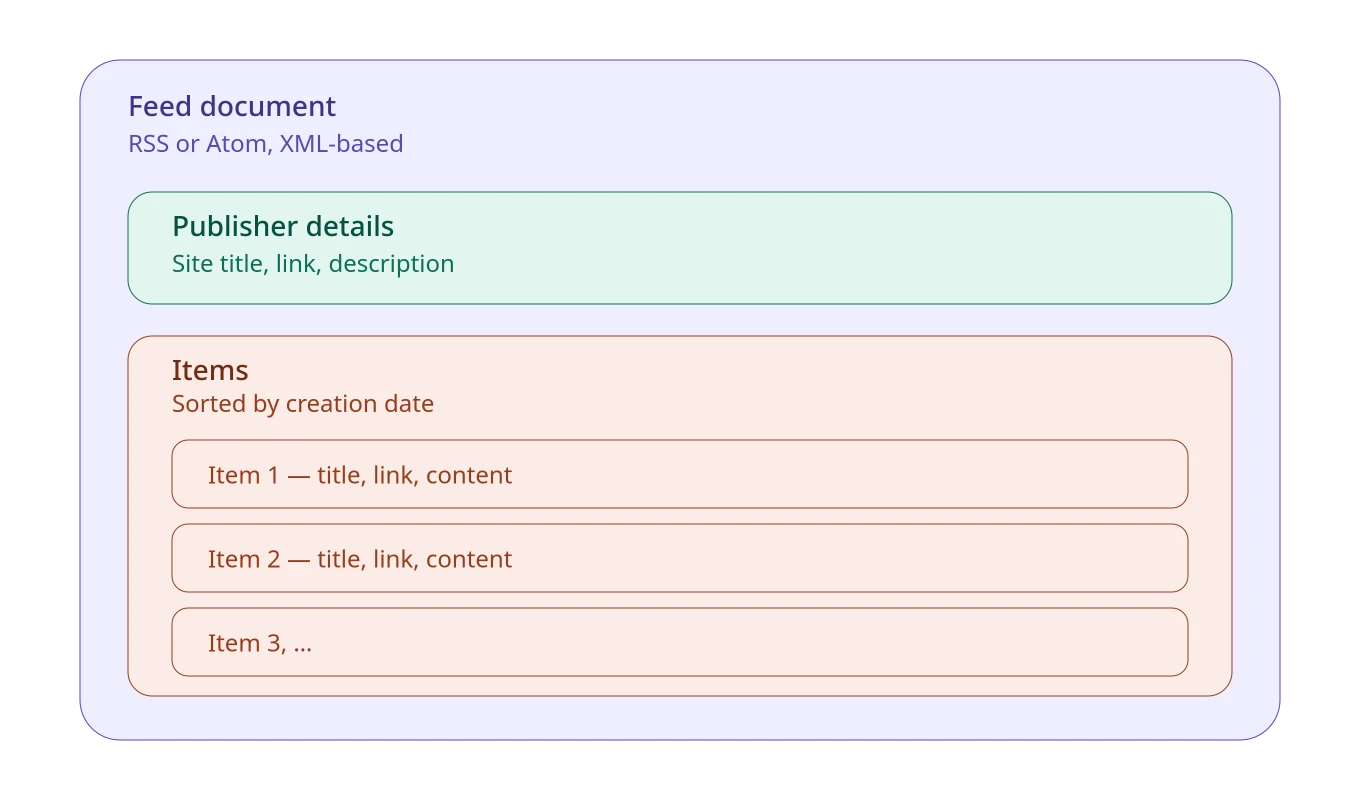
Items are usually sorted by their creation date. The number of items is not capped or limited, but generally most feed publishers will expose a rolling number of items, with older items being removed after some period.
Both formats include publisher details that make the files self-contained, allowing them to be shared or published elsewhere than the source website, and retain the necessary details to link back to that source.
Being self-contained and capping the number of items is important, as these formats are literally downloaded as a file to your feed reader. They aren’t a “stream” of data that a server sends to a client. They are a full file, like a word document, you download and parse. So keeping the size constrained and ensuring it contains relevant metadata and sources is vital.
Unlike a web page, these formats contain minimal styling and other than the structure shown above, its left to the end consumer to format them as they wish. This gives you a lot of flexibility in how to display feeds, though most feed readers default to an inbox-like display. IMO, treating feeds like email is a bad user experience and Foragd is intentionally different.
One key feature is that they support extensions that provide a way to add functionality to their base layouts and often the same extensions work in both formats due to them sharing the XML base format. With extensions, you can link to audio and video objects that can be then rendered with the display of the RSS/Atom file (these formats power podcasts in this way). You can even add extensions for geographical coordinates, allowing the items to be displayed on a map.
The Differences
First off, Mark Nottingham (who authored the Atom spec) has run some numbers that show that RSS is implemented more often than Atom. As Mark notes, this likely is not meaningful as a decision key on which to implement. Popularity is not a good indicator of superiority.
Atom is much more expressive in terms of the structure that defines items in the feed. RSS has less rigidity, but ultimately both cover all the canonical structure you’d expect for items, like titles, descriptions, content, and media elements. Wikipedia has a good quick comparison of the difference in structure between the two.
Which Should You Use?
As an end user: If you have a choice, pick either as nearly all good feed readers, like Foragd, support both formats. As they provide near identical features, the choice as a consumer of the feed is irrelevant. Your feed read will control how they are displayed, so focus on finding a feed reader that has the features and layout you like.
As a developer: If you are looking to add a feed to your project, use whichever format your framework or service readily provides. Minimal implementation effort should be your focus, as the provided structure of either is functionally equivalent, and any additional features you can get through common extensions. For your end-users, it won’t matter as the app or service they use to consume your feed will support both formats and is ultimately in control of how your feed will be displayed.
Shameless plug: If you are a Go developer, you might be interested in go-syndication, which provides reading and writing for RSS, Atom, JSONFeed, and a number of extensions for these formats.
If you want the full details, both specifications are surprisingly easy to read (see references below).
Getting started with RSS and Atom feeds? Foragd is free to try for 30 days — no commitment needed. Sign up.
References
- https://en.wikipedia.org/wiki/Web_feed
- https://en.wikipedia.org/wiki/RSS
- https://en.wikipedia.org/wiki/Atom_(standard)
- https://www.rssboard.org/rss-specification
- https://www.rfc-editor.org/info/rfc4287/
License: CC BY-SA 4.0.